

The Ministry of Communication, Technology and Innovation (MoCTI), with support from the Sierra Leone Digital Transformation Project (SLDTP) funded by the World Bank, has handed over a new set of assistive devices to four disability institutions across Sierra Leone. This initiative is part of the Government’s commitment to promoting digital inclusion and ensuring that persons with disabilities can benefit equally from the country’s ongoing digital transformation.

Building on Success
In early 2024, the SLDTP supported MoCTI to provide assistive devices to two institutions in Freetown; the Milton Margai School for the Blind and the National School for the Deaf. These institutions received laptops, tablets, digital recorders, smart TVs, styluses and frames, and specialized paper materials to support inclusive learning and communication.
Following the success of that phase, the Ministry has now extended support to a second group of institutions that play a vital role in educating and training persons with disabilities. The new beneficiaries include:
Bombali School for the Blind – Makeni
Opportunity Training Center – Kenema
Educational Center for the Blind and Visually Impaired – Freetown
Dorothy Springer Trust – Freetown
A Collaborative Selection Process

The selection of institutions was guided by a thorough assessment process carried out in collaboration with the Universal Access Development Fund (UADF). The team evaluated the needs and capacities of several disability institutions across the country to identify where the greatest impact could be made. Factors considered included the institution’s role in supporting persons with disabilities, existing resources, and readiness to integrate technology into their programs.
Institutions such as the Dorothy Springer Trust and the Educational Center for the Blind and Visually Impaired were assessed in the first phase but were not included due to budget limitations. This second phase has now prioritized their inclusion, ensuring continuity and fairness in the allocation process.
Empowering Learning Through Technology
The assistive devices provided under this phase are designed to enhance teaching, learning, and vocational training for persons with disabilities. They include: Computers with NDVA software for visually impaired users Braille note takers and embossers for creating and reading tactile text
Scanners and book readers to support accessible learning materials Smart TVs, printers, and dual-channel headphones for multimedia learning Braillers, digital recorders, white canes, and writing frames for literacy and mobility support Wireless cards, braille papers, and continuous paper to aid daily operations and accessibility. These tools will significantly improve the ability of teachers and students to interact with technology, access information, and participate more actively in academic and vocational activities.
A Step Toward an Inclusive Digital Future
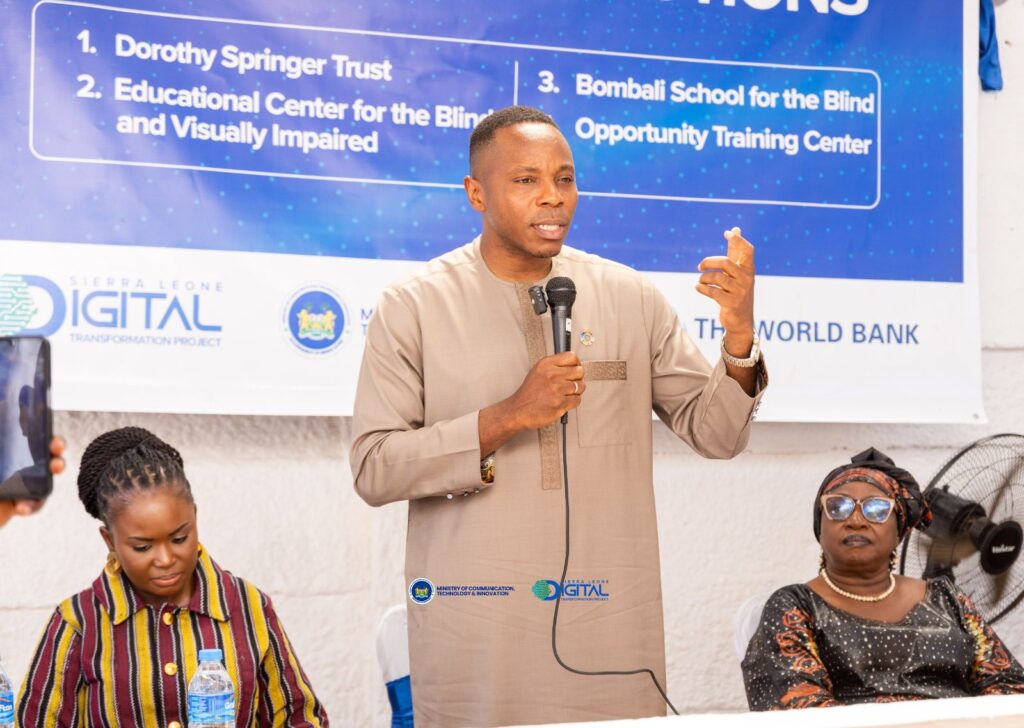
The handover ceremony, attended by the Chief Minister, Dr. David Sengeh, celebrated the Government’s progress in building a digitally inclusive Sierra Leone. The Chief Minister reaffirmed the administration’s commitment to ensuring that digital transformation benefits everyone, including persons with disabilities.
This initiative underscores the vision of the Sierra Leone Digital Transformation Project, to create a connected, inclusive, and accessible digital ecosystem that empowers all citizens to thrive in a rapidly evolving technological landscape.